
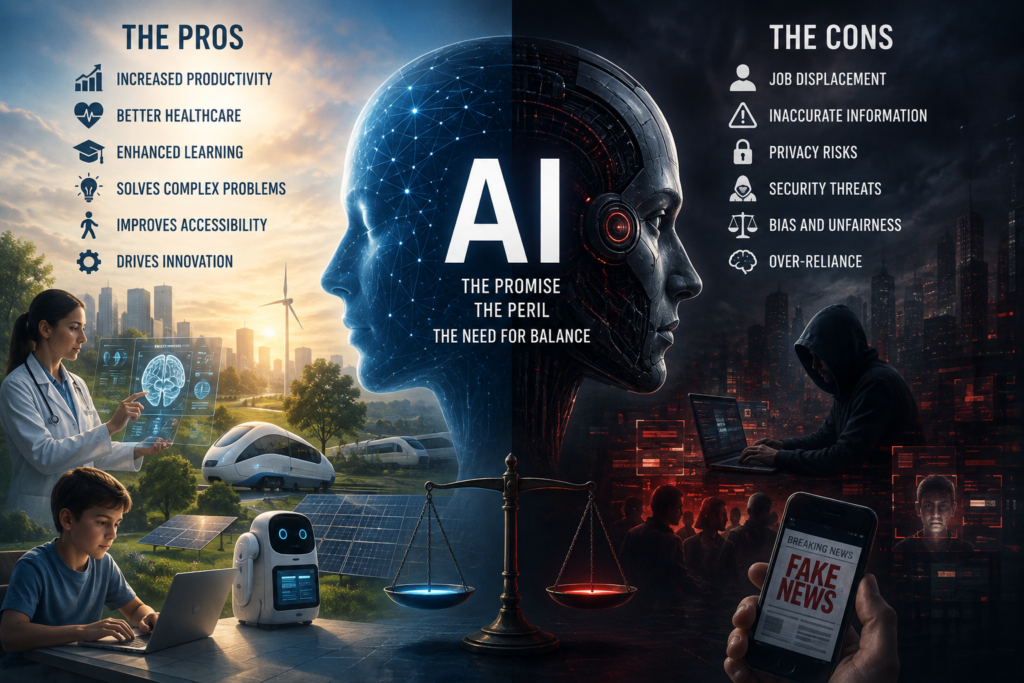
Artificial intelligence has moved from the realm of science fiction into nearly every part of our daily lives. From virtual assistants and automated customer service to medical research, cybersecurity and self-driving technology, AI is changing how we work, communicate and make decisions. Its potential is enormous—but so are the concerns surrounding it. As society embraces this rapidly developing technology, the challenge is finding the right balance between innovation and responsibility.
One of the greatest advantages of AI is its ability to process enormous amounts of information quickly. A task that might take a person hours—or even days—can sometimes be completed by an AI system in seconds. Businesses are using AI to analyze data, identify trends, improve customer service and automate repetitive tasks. This can increase productivity while allowing employees to spend more time on creative and strategic responsibilities.
AI is also making significant contributions to healthcare. It can help doctors analyze medical images, identify patterns that might otherwise be missed and assist researchers in developing new treatments. In other fields, AI is being used to improve weather forecasting, detect fraud, strengthen cybersecurity and assist emergency responders. When properly designed and supervised, these capabilities can save time, money and even lives.
Another major benefit is accessibility. AI tools can help people translate languages, summarize complicated information, generate written content and assist individuals with disabilities. For students and professionals, AI can serve as a powerful research and brainstorming tool. Used correctly, it can enhance human capabilities rather than replace them.
However, the rapid growth of AI comes with significant risks.
One of the biggest concerns is employment. As AI becomes better at performing tasks traditionally handled by people, some jobs will inevitably change or disappear. Customer service, administrative work, data entry, transportation and even certain professional services could be significantly affected. While new jobs will likely emerge, workers may need new skills to remain competitive. The transition could be particularly difficult for people whose occupations are disrupted faster than they can adapt.
Accuracy is another concern. AI systems can produce incorrect information while presenting it with remarkable confidence. These errors—sometimes called “hallucinations”—can be harmless when generating a creative story but potentially dangerous when AI is used for medical, legal, financial or security decisions. The lesson is simple: AI should not automatically be treated as an authority simply because it sounds convincing.
Privacy and security present additional challenges. AI systems can process enormous quantities of personal information, raising questions about who has access to that data and how it is being used. At the same time, criminals are using AI to create more convincing phishing emails, impersonate individuals, generate fraudulent images and videos, and automate cyberattacks. The same technology that can protect us can also be weaponized against us.
There is also the danger of losing the human element. If people become overly dependent on AI to write, think, research or make decisions, critical-thinking skills could deteriorate. Convenience can become dependence, and dependence can create vulnerability.
Ultimately, AI is neither inherently good nor bad. It is a tool—and like any powerful tool, its impact depends largely on how people choose to use it. The goal should not be to stop AI’s development, but to ensure that innovation is accompanied by appropriate safeguards, transparency, accountability and human oversight.
The AI revolution is already here. The question is no longer whether artificial intelligence will change our lives. The question is whether we will be smart enough to make sure those changes benefit society while protecting the values, privacy, security and human judgment that make us who we are.