
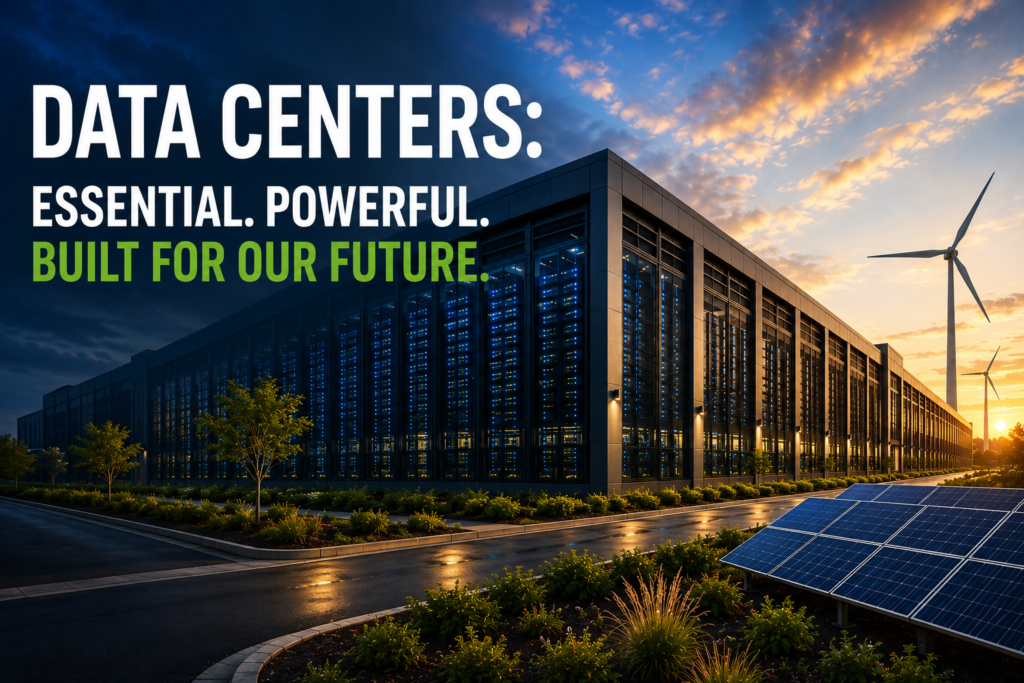
Few modern developments have generated as much debate as the rapid construction of data centers. These massive facilities, filled with computer servers and sophisticated networking equipment, are appearing across the country to support cloud computing, artificial intelligence, streaming services, online banking, business applications and countless other digital services. While politicians and critics raise legitimate concerns about electricity consumption, water use, noise and their impact on local communities, there is another side to the story: data centers are not simply buildings filled with computers. They are becoming essential infrastructure for the modern economy.
Much of the controversy centers on the enormous amount of electricity required to operate and cool these facilities. As artificial intelligence becomes more sophisticated, the computing power required to train and operate AI systems is increasing dramatically. Communities understandably question whether their electrical grids can handle the additional demand and whether residents will ultimately bear higher costs.
Water usage is another concern. Like other already existing industries (agricultural, golf courses, etc.) some data centers use water-based cooling systems, raising questions in areas where water resources are already limited. Although the water used by data centers is generally not potable, there are also concerns about the environmental impact of constructing large facilities, their visual presence and the noise generated by cooling equipment and backup generators.
These concerns should not be dismissed. Data centers should be carefully planned, regulated and designed to minimize their impact on surrounding communities. Companies should be transparent about their energy and water consumption, invest in efficient cooling technologies and work with utilities to ensure that new demand does not compromise grid reliability.
But focusing only on the negatives overlooks why these facilities are being built in the first place.
Almost every aspect of modern life depends upon data centers. When we send an email, make a bank transaction, use a navigation app, stream a movie, store photographs in the cloud or conduct a video conference, data is being processed and stored somewhere. Businesses rely on cloud computing to operate their websites, manage financial records, communicate with customers and protect critical information. Hospitals, universities, government agencies and emergency services increasingly depend upon the same digital infrastructure.
The growth of artificial intelligence makes data centers even more important. AI systems require enormous computing resources to develop, operate and improve. AI is already being used for medical research, cybersecurity, weather forecasting, manufacturing, transportation, scientific discovery and countless other applications. Without the computing infrastructure to support it, much of AI’s potential simply cannot be realized.
There are economic benefits as well. Data center construction creates jobs and generates significant economic activity. Once operational, facilities require engineers, technicians, electricians, security personnel, maintenance workers and other professionals. They can also contribute substantial tax revenue to local governments, potentially supporting schools, public services and infrastructure.
Perhaps most importantly, data centers contribute to technological and national security. Modern economies depend upon reliable access to computing and communications. Businesses and governments need secure systems capable of storing and processing enormous quantities of information. As cyber threats become more sophisticated and nations compete for technological leadership, having secure and reliable computing infrastructure is increasingly a strategic necessity. And if the United States chooses to ignore this need, other countries, to include hostile nation states, will not.
The answer, therefore, should not be to stop building data centers. Instead, communities and technology companies should demand that they be built responsibly.
That means locating facilities where adequate power and water resources exist, investing in renewable and alternative energy sources, improving cooling efficiency, recycling water where practical and strengthening electrical infrastructure. It also means requiring companies to communicate honestly with communities about expected impacts and benefits.
Data centers may not be glamorous, and they certainly are not without costs. But they are the physical foundation beneath much of the digital world we now take for granted. The question is not whether society needs data centers—we clearly do. The real question is how we can build the infrastructure we need while being responsible stewards of energy, water, the environment and the communities where these facilities operate.
Technology is not slowing down. Neither is our dependence upon it. If we want the benefits of cloud computing, artificial intelligence, digital healthcare, cybersecurity and the connected economy, we will need the infrastructure that makes them possible.