
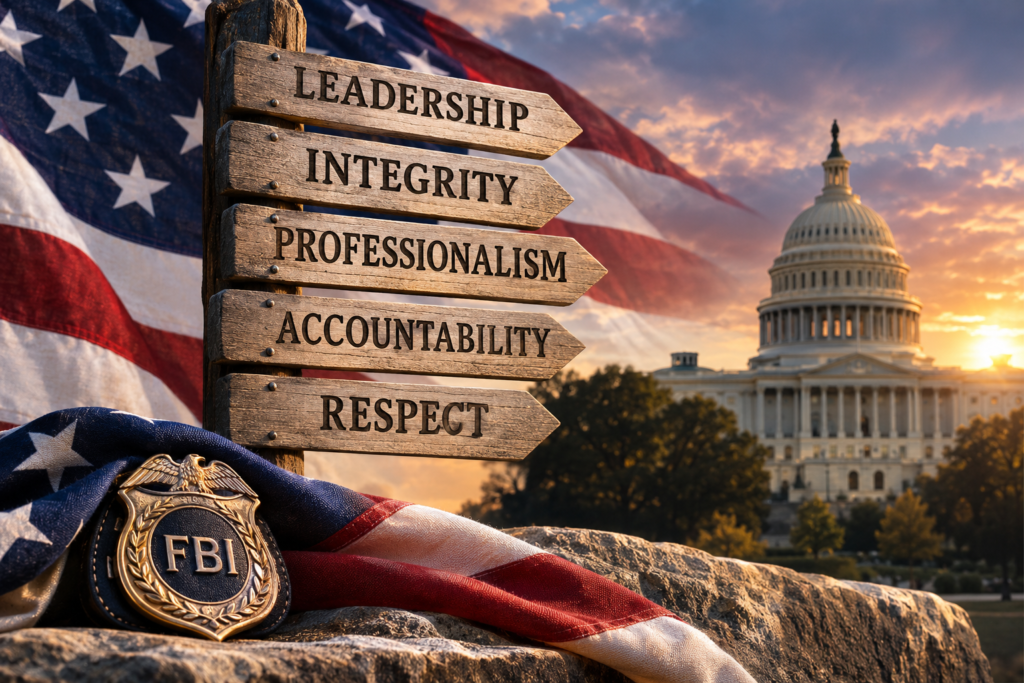
What the FBI Taught Me About Leadership, Integrity, and Respect
With the election behind us, Americans are once again reminded of how deeply we can disagree about the direction of our country. Elections bring passionate debate, strong opinions, victories, and disappointments. For some, the results represent hope and a new beginning. For others, they bring frustration and uncertainty. But regardless of which side celebrates or which side questions the outcome, there is something more important than winning or losing: how we conduct ourselves afterward.
During my 20 years as an FBI Special Agent, I learned lessons about leadership, integrity, and professionalism that extend far beyond law enforcement. I participated in some of the most significant investigations in our nation’s history, worked alongside dedicated professionals, and witnessed firsthand the importance of putting the mission ahead of individual interests. One lesson consistently stood out: character is not measured by how we behave when things go our way, but by how we respond when they don’t.
Leadership Means Putting the Mission First
In the FBI, our mission was bigger than any one individual. It didn’t matter whether an investigation was receiving national attention, whether our decisions were popular, or whether we personally agreed with every circumstance surrounding an assignment. Our responsibility was to follow the facts, uphold the law, and serve the American people.
Effective leaders understand this principle. They recognize that leadership is not about personal recognition, winning arguments, or always getting their way. It is about accepting responsibility, making difficult decisions, and serving something greater than themselves.
The same principle applies to our elected officials and those who aspire to lead. Public service is exactly that: service to the public. An elected position is not a personal trophy or an opportunity to settle scores. It is a responsibility entrusted to an individual by the people.
Whether celebrating a victory or accepting a defeat, leaders should remember that their obligation extends beyond those who voted for them. They represent all Americans, including those who disagreed with them.
Integrity Means Respecting the Process
One of the most important lessons from my law enforcement career is that integrity requires us to respect facts, evidence, and established procedures, even when the results are not what we hoped for.
Investigations cannot be conducted based on personal feelings, assumptions, or desired outcomes. We follow the evidence wherever it leads. If the facts contradict our original theory, we adjust our thinking. If we make a mistake, we acknowledge it and correct it. That is not weakness; it is professionalism.
Elections deserve the same commitment to facts and established processes. Americans have every right to ask questions, express concerns, and seek answers when legitimate issues arise. Transparency and accountability are essential to public confidence. But allegations should be supported by evidence, and disputes should be addressed through the appropriate legal channels.
We cannot demand accountability from others while refusing to hold ourselves to the same standard. Nor can we expect the public to respect institutions if those in positions of influence disregard the rules whenever the outcome is inconvenient.
Integrity is not something we practice only when it benefits us. It is a standard that must remain consistent, especially when circumstances are difficult.
Professionalism Means Accepting Both Victory and Defeat
Throughout my career, I worked with people who had different backgrounds, beliefs, personalities, and opinions. We didn’t always agree, but we understood that professionalism required us to work together.
In law enforcement, there is no room for allowing personal disagreements to interfere with the mission. We learn to separate our personal feelings from our professional responsibilities.
That is a lesson worth remembering after an election. Winning does not give someone permission to gloat, belittle, or dismiss those who supported the other side. Losing does not justify threats, intimidation, or refusing to participate in the process.
Disagreement is a healthy part of a democratic society. Personal attacks, harassment, and violence are not.
We should be able to debate policies passionately without treating our neighbors as enemies. We should be able to challenge elected officials without threatening them. And we should be able to celebrate a political victory without humiliating those who supported the opposition.
True leadership is demonstrated through restraint, humility, and respect.
Accountability Is a Responsibility, Not an Option
In the FBI, accountability was part of the job. Decisions had consequences, reports had to be accurate, and actions had to withstand scrutiny. When something went wrong, the expectation was not to point fingers or make excuses. It was to determine what happened, learn from it, and make improvements.
Our political leaders should be held to the same standard. Voters have the right to expect honesty, transparency, and responsibility from those entrusted with public office. And those who hold public office should be willing to accept criticism, acknowledge mistakes, and answer difficult questions.
But accountability is not reserved for politicians. Each of us has a responsibility for the tone of our public conversations, the information we share, and the way we treat people with whom we disagree.
Before forwarding an inflammatory social media post, consider whether it is accurate. Before making an accusation, consider whether it is supported by facts. Before responding in anger, consider whether your words will contribute anything constructive.
America Is Bigger Than an Election
After 20 years in the FBI, I came away with a profound appreciation for the people who dedicate their lives to serving this country. I worked with individuals who put their personal interests aside because they believed in something bigger than themselves.
That same spirit is what America needs today.
Political parties will compete. Candidates will win and lose. Policies will change, and debates will continue. That is the nature of our democracy. But our commitment to the Constitution, the rule of law, and the principles that unite us should never depend on which candidate occupies the White House or which party controls Congress.
I never took an oath to protect a political party or a particular candidate. I took an oath to uphold the Constitution and serve the American people. That commitment did not change depending on who was in office, and it should not change for any of us based on the outcome of an election.
Winning is temporary. Losing is temporary. Character, integrity, and respect are lasting.
The true measure of leadership is not simply how we win, but how we conduct ourselves when we do. And perhaps the greatest victory we can achieve as Americans is remembering that, despite our differences, we are all on the same team.
The election may be over. The responsibility to lead, serve, and respect one another continues.